
Edge modulesBilling Module
Revolutionizing billing
Precise and timely consolidated bills, across a diverse array of billing media. The Edge billing module eliminates the traditional link between metering and billing.
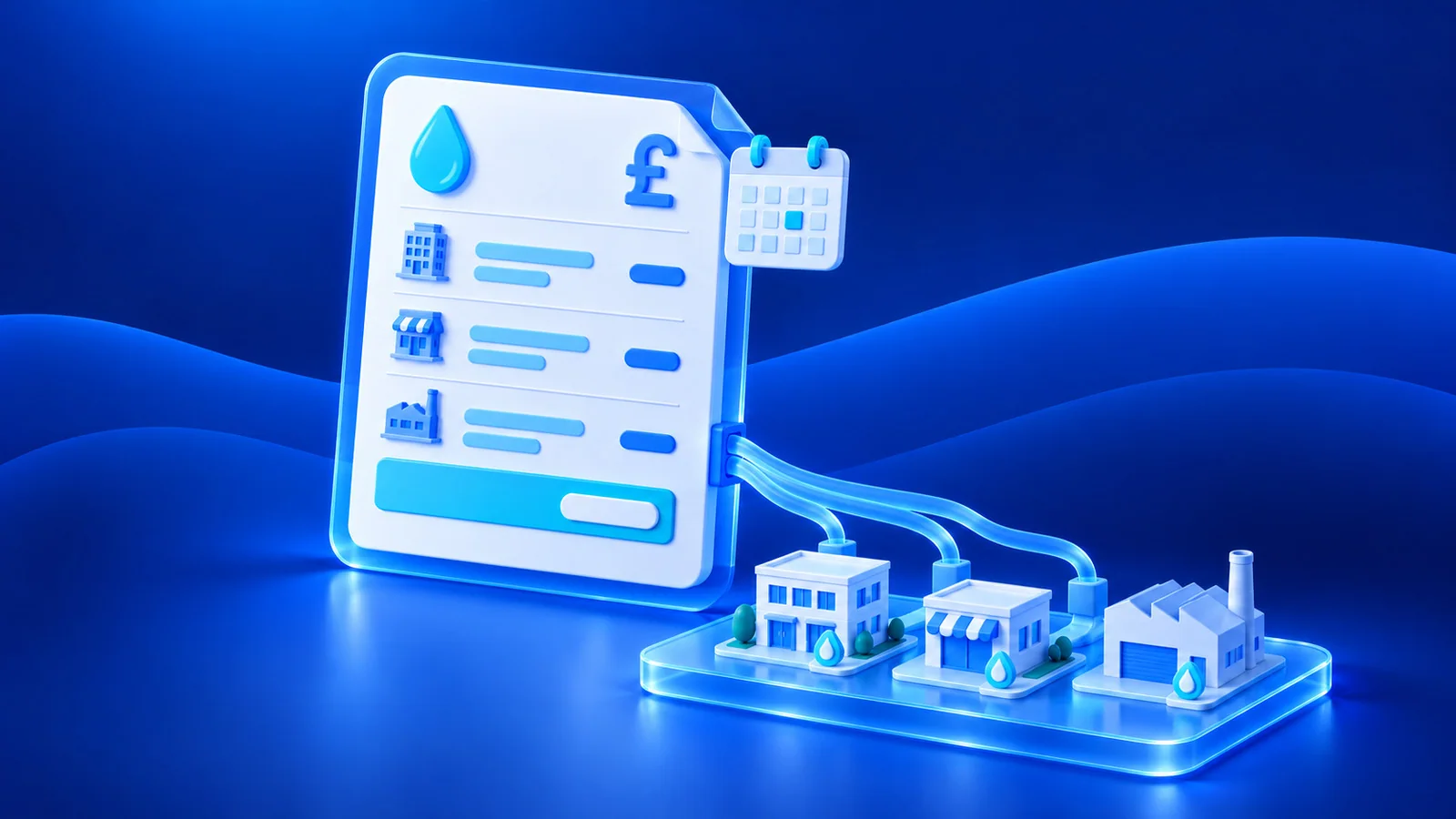
- Manual, semi-automated or fully-automated billing
- 3 methods
- Printed, .pdf, .xlsx and XML bills, set at Account level
- 4 formats
- English and Scottish SPIDs on one consolidated account
- 2 markets
Challenges with current billing practices
Many metered utility variable charges operate on an arrears basis, relying on either “actual” or “estimated” meter reads. While this method simplifies bill calculations, it comes with two significant drawbacks.
- Delayed billing creates cashflow challenges. Bills are generated only “in arrears,” leading to potential cashflow challenges for businesses, especially in competitive markets where settlement charges are incurred “in advance.”
- Consolidation complexity. Creating truly consolidated customer bills becomes a formidable task due to the inherent difficulty in aligning meter readings for different premises within a consolidated account. This limitation hinders the efficiency of billing processes and overall customer experience.
Billing without the link to metering
Our Edge billing module effectively eliminates the traditional link between metering and billing. The Edge billing algorithm calculates an Average Daily Consumption (ADC), similar to Central Market Operators’ practices for Settlement charges.
ADC removes the need to enter estimated meter readings. It does not mean that every billed consumption value is an actual one: days not yet covered by a read are charged at the Supply Point’s average daily consumption, and trued up once the next actual read arrives. Customer Briefing Note 002 sets out the distinction in full.
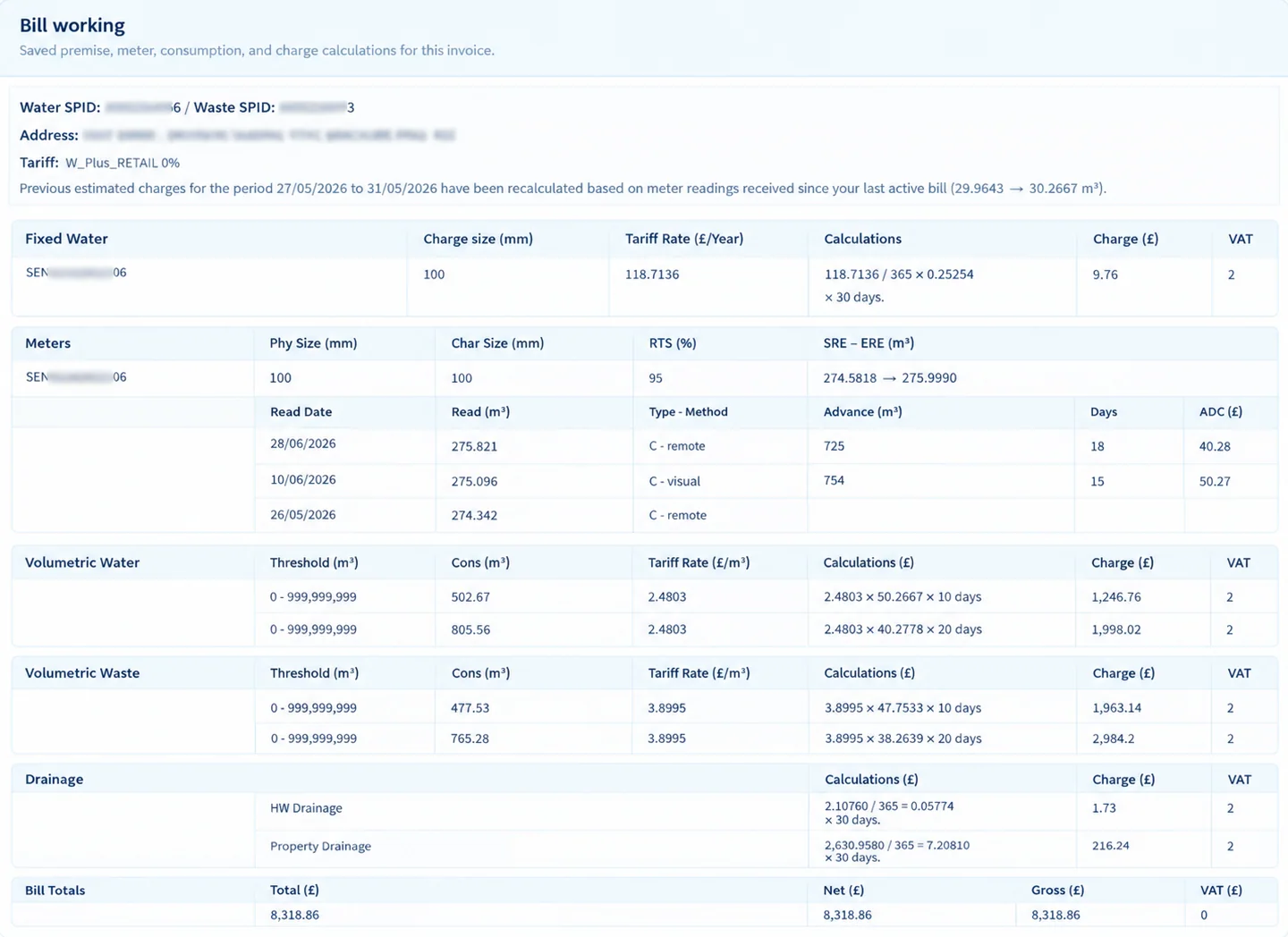
How it works
From average daily consumption to a bill
Calculate the ADC
The Edge billing algorithm computes the ADC for each of the services associated with each SPID, ensuring accuracy in daily charge calculations.
Aggregate the daily charges
These daily charges are then aggregated to present customers with a comprehensive charge for the billing period.
Adjust at the next cycle
The ADC is intelligently adjusted at the next billing cycle, accommodating any new meter reads seamlessly.
One-stop solution
Benefits of the ADC billing methodology
Overcoming traditional constraints, Edge disconnects metering from billing through its advanced algorithm.
No estimated meter reads
No estimated readings to calculate and load – consumption between actual reads is derived from ADC and corrected at the next read.
Advanced billing capabilities
Enjoy the flexibility to bill in advance, providing a strategic advantage in competitive markets.
Customizable billing periods
Empower your customers with fixed billing periods independent of meter readings, offering choices like 28 days, monthly, quarterly, or annually.
True consolidated billing
Embrace true consolidated billing, freed from traditional constraints. Our method ensures seamless integration and accuracy across diverse services.
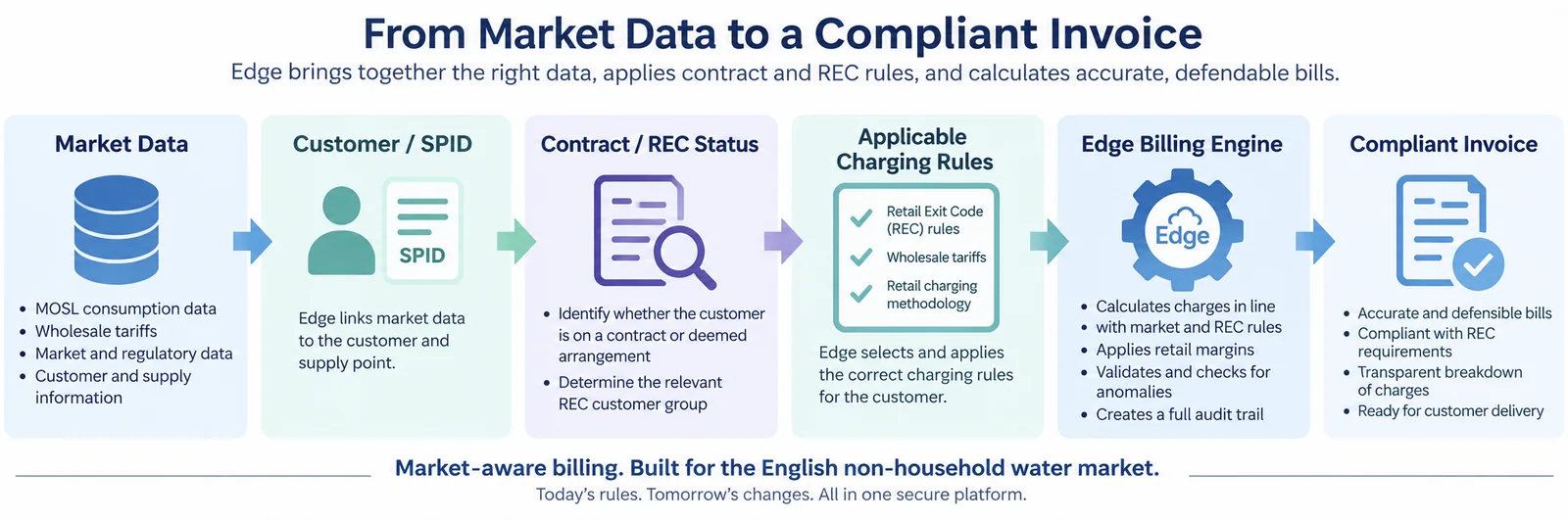
Billing that understands the Retail Exit Code
For English water retailers, accurate billing isn’t simply a matter of applying the correct wholesale tariff and retail margin.
Customers supplied under deemed or default arrangements may be protected by the Retail Exit Code (REC), which places requirements on the prices and terms that retailers can apply.
Edge brings these rules into the billing process.
For each SPID, Edge identifies the appropriate charging methodology and applies the relevant REC rules when calculating customer charges. This helps retailers to:
- Distinguish between contracted and REC-protected customers
- Apply the appropriate retail charging methodology
- Calculate permitted charges consistently across water and wastewater services
- Accommodate the different treatment of REC customer groups
- Maintain a transparent audit trail showing how the customer charge was derived
The result is more than accurate billing. It is market-aware billing, designed specifically for the English non-household water market.
As REC requirements evolve, Edge is updated centrally so that retailers do not have to recreate complex regulatory charging logic in spreadsheets or manual processes.
Scroll sideways to see the whole diagram.
Consolidated bills without simultaneous meter readings
Traditionally, consolidated bills faced limitations due to billing systems requiring billing to actual or estimated reads, often necessitating synchronization of all meters on the same day. Monthly consolidated bills were typically a compilation of invoices billed within that specific month. With Edge, a paradigm shift occurs.
- Flexible billing based on ADC. Edge enables billing for all SPIDs based on ADC on a designated day of the month or any other preferred period. This flexibility eliminates the need for simultaneous meter readings.
- Comprehensive consolidation. Unlike conventional practices, Edge consolidates all Account SPIDs seamlessly, transcending the limitations of monthly billing cycles.
- Nationwide integration. Edge extends its consolidation capabilities to both English and Scottish markets, allowing the creation of consolidated accounts at a UK level, encompassing SPIDs from both regions.
Tailored bills, in the format each Account needs
Utilizing SQL Server Reporting Services (SSRS), Edge introduces a dynamic approach to bill creation, accommodating various output formats and allowing for tailored appearances that precisely match customer requirements.
Edge provides the flexibility to change the output format for bills at an Account level.
- Printed bills. Traditional format for postal delivery.
- Electronic (.pdf) bills. Conveniently sent via email.
- Excel (.xlsx) billing spreadsheet. A flexible 3-tab spreadsheet.
- XML formatted bills. Ideal for EDI integration.
Bill creation
Discover unmatched flexibility with Edge billing
The Edge Billing module offers an exceptionally adaptable approach to bill creation, providing users with three distinct methods.
Manual billing
Experience ad hoc billing as needed, allowing users the flexibility to create bills on-demand.
Semi-automated billing
Streamline the process by loading a list of Accounts and Billing dates to Edge daily. Bills are then generated seamlessly in an overnight billing run.
Fully-automated billing
Harness the power of predefined Account Billing settings to establish the preferred bill period and date. Bills are then generated in an overnight billing run.
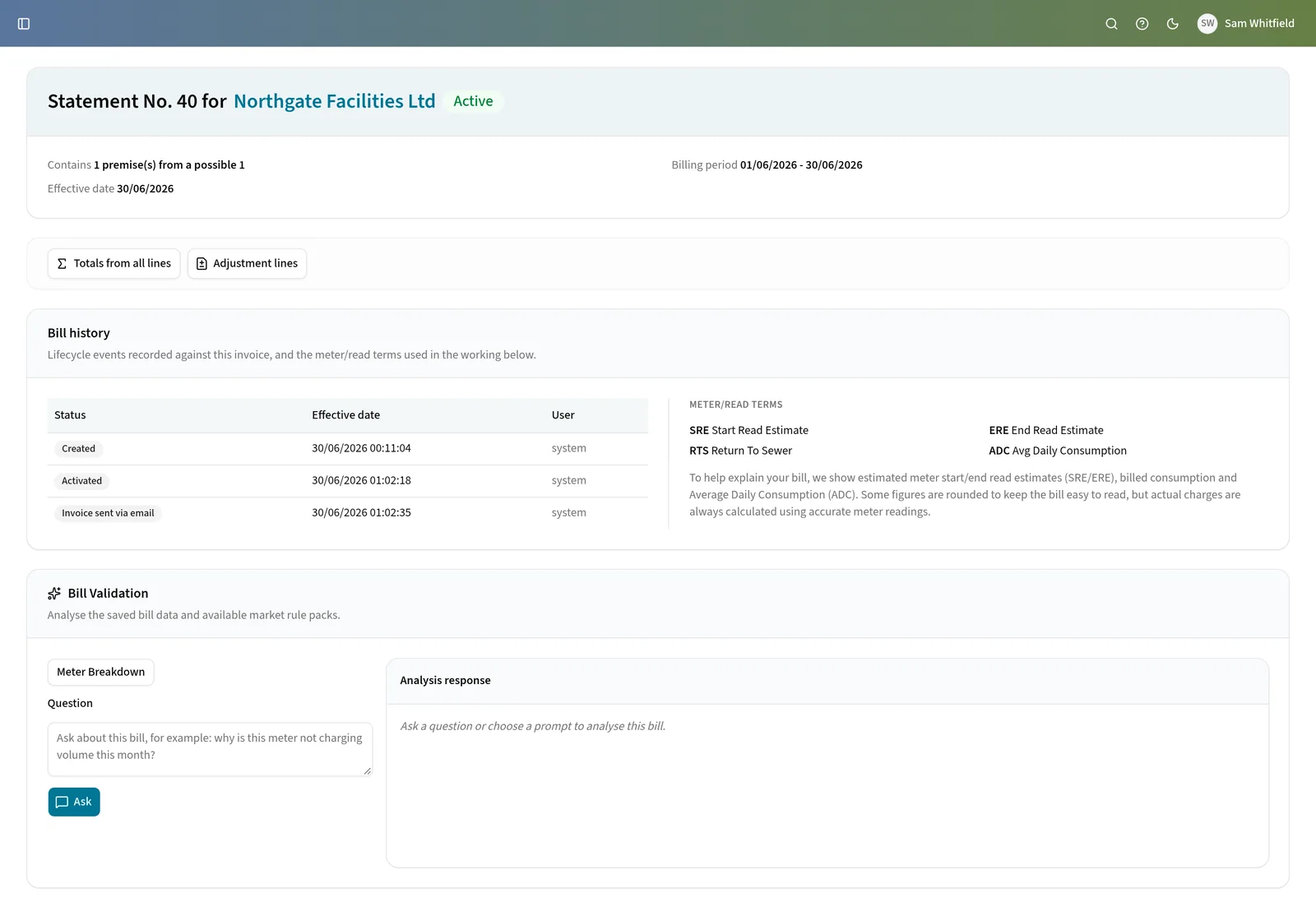
Bill validation on demand
Complex billing structures are hard to check by eye – block tariffs, volumetric adjustments and consolidated accounts spanning both the English and Scottish markets all compound one another.
Edge checks them for you, on demand. Run Bill Validation when you need it to confirm that calculations behave as expected, and to investigate a discrepancy before it reaches the customer as a query. Bill Validation continues to develop, with further enhancements planned.
Reconstruct a bill as it was – and as it should have been
Billing data changes after the event. A read is corrected, a tariff is backdated, a market record is restated, and the bill you sent no longer matches the data you hold today.
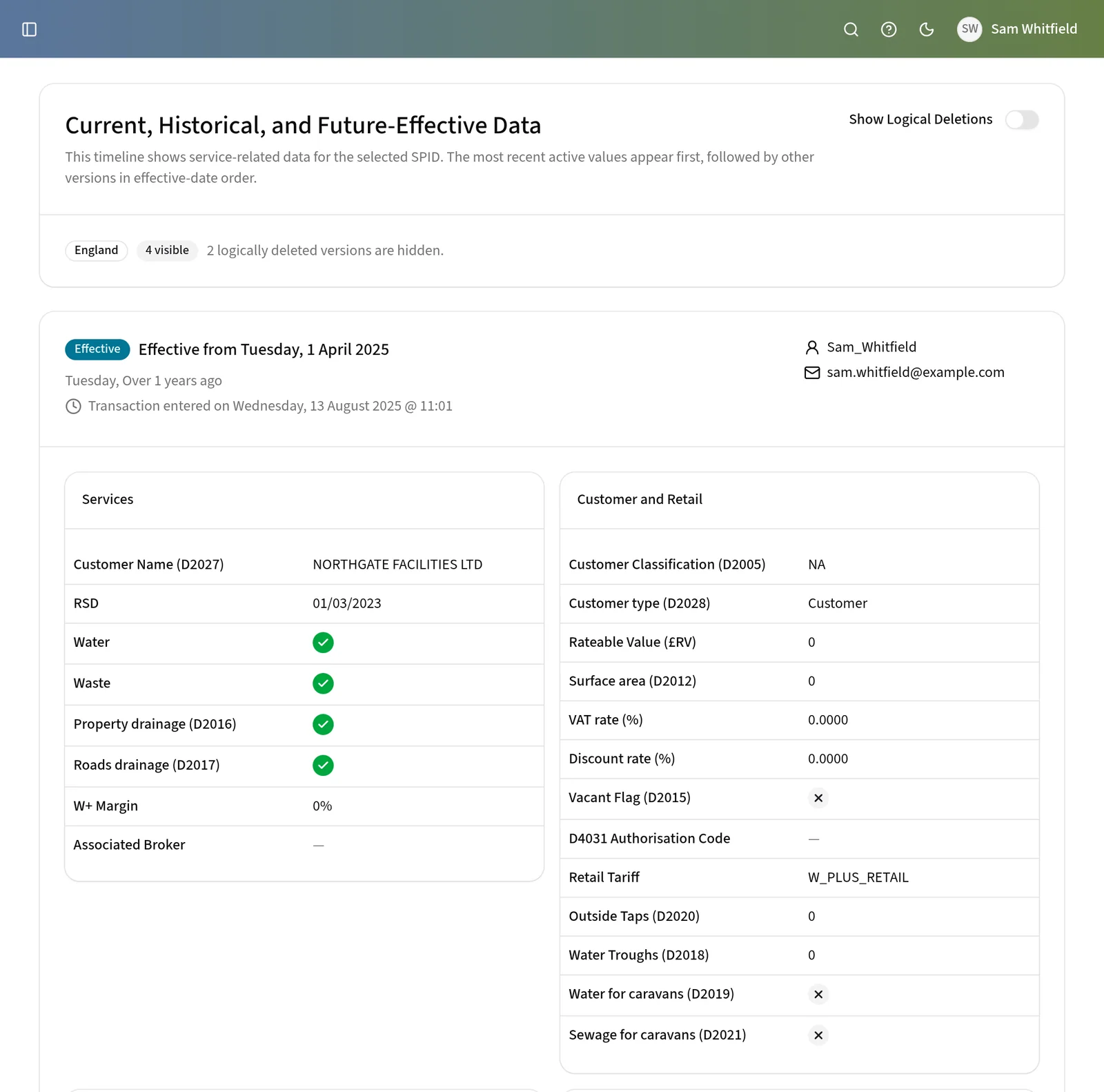
Edge records both when something was true and when you learned it was true. A historical bill can therefore be reproduced exactly as it looked on the day it was issued, and set alongside the version that reflects every correction made since.
Queries are answered with evidence rather than rebuilt by hand, and corrections can be re-billed without losing the original position. Customer Briefing Note 012 explains the underlying bi-temporal model.
Frequently asked questions
Questions retailers ask about Billing
How does Average Daily Consumption (ADC) billing work in Edge?
Edge calculates customer bills on an Average Daily Consumption curve derived from validated meter reads, rather than relying on arbitrary estimated reads. This eliminates the traditional delay between meter reading and billing, and ensures consistent and predictable billing cycles.
Can Edge combine English and Scottish water SPIDs on one bill?
Yes. Edge is built for UK-wide operations. A customer account can hold supply points from both England (MOSL) and Scotland (CMA), with consolidated billing presented across all premises on a single schedule.
What bill output formats does Edge support?
Edge supports multiple invoice formats configured at individual account level: printed hard copy, PDF, Excel (.xlsx) workbooks, and structured XML files for electronic data interchange (EDI).
How are retrospective adjustments and tariff corrections handled?
Edge uses a bi-temporal data model that preserves both the transaction date and the discovery date. You can reproduce a historical bill exactly as issued on that day, or recalculate the revised position showing the exact adjustment caused by backdated reads or tariff changes.
Works with
Modules that pick up where this one leaves off
- Meter Read ModuleMeter reads are validated as they are loaded, ready for the ADC to be adjusted at the next billing cycle.
- Payment Module and BACSWorks in collaboration with Billing, with the payment method defined at Account level.
- Debt Management ModuleA real-time assessment of customer account debt, integrated with Billing and Payment.
- Settlement ModuleDetects mismatches between wholesaler invoices and customer billing, down to SPID and month.
Explore How Edge Could Support Your Retail Operation
If you’d like to understand how Cloudwater Edge could support your business, we’d be happy to talk through your current setup, challenges and plans.
Book a conversation